Nainers & Goh INterview
In Conversation with Nate Nate Nainers
Interviewed By Kagan Goh
Book Launch Q&A — Three Questions for the Poet
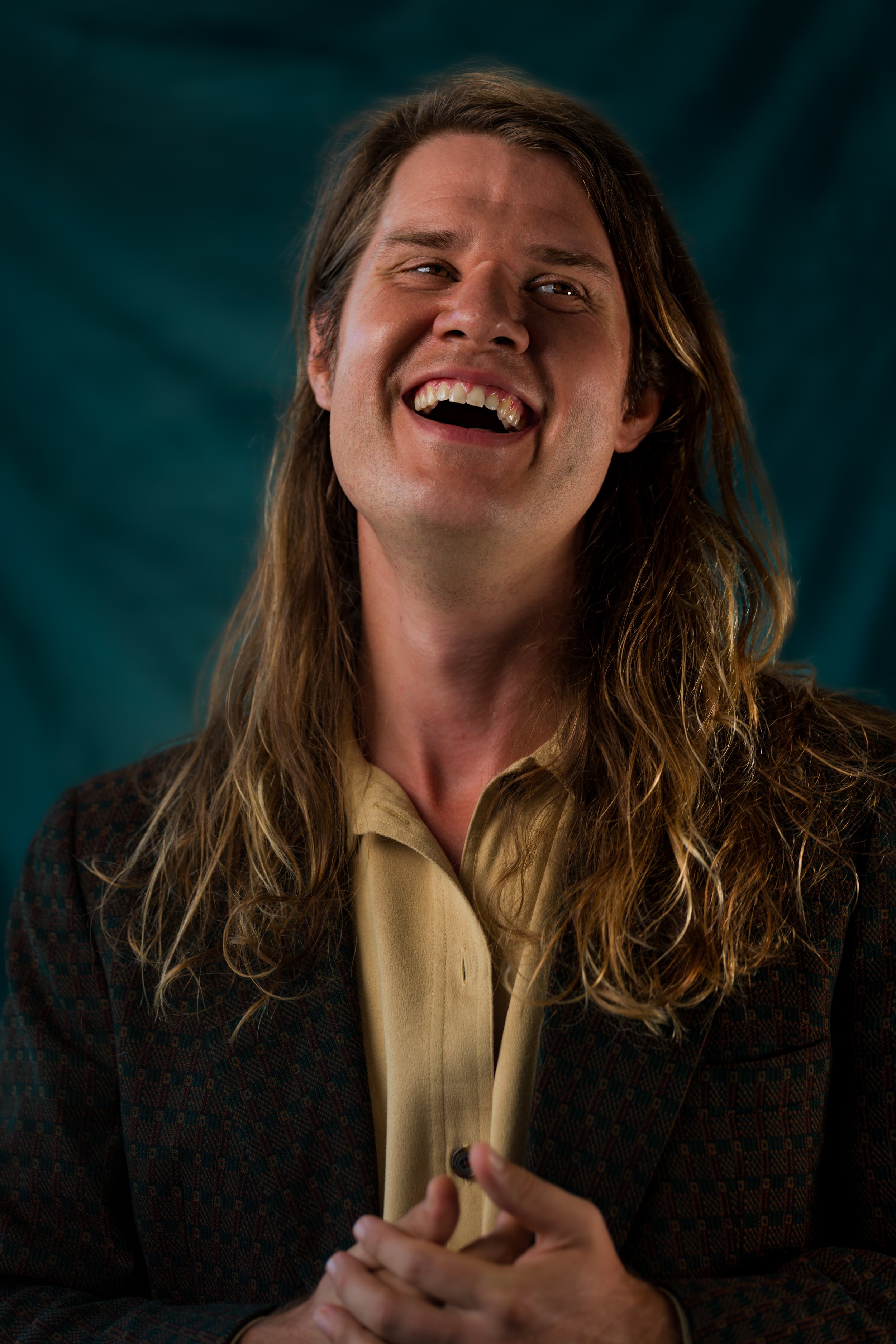
Photographer: NIcco Dicceco
Nate Nate Nainers (they/she) is an award-winning storyteller, poet, and performance artist based on the unceded territories of the Kwikwetlem and Stó:lō First Nations (Port Coquitlam, BC). Their second book, Smokin’ Holy Spirts (Galleon Books) explores the fall-out of leaving the evangelical church in six simple steps to quit smoking. They are proudly schizoaffective, bisexual, and claim the gender designation of Gorgeous.
Kagan Goh is an award-winning filmmaker, published author, spoken word poet, playwright, actor, mental health advocate, and activist. After reading a copy of Smokin’ Holy Spirits by Nate Nate Nainers, Goh interviewed Nainers about their work.
GENDER IDENTITY
KG: Poems like “clothing swap philosopher” and “monday funday” sit right next to years spent inside evangelical church spaces. As a trans-femme poet, how has claiming your gender identity changed not just what you write about, but the way language itself moves on the page — the rhythm, the line breaks, the voice?
NNN: The construction of my poems’ form is intuitive. In fact, most of my work is intuitive. When and where I place the words on the page - how I split stanzas or separate a phrase - is part of the way-finding on the first draft. I slip through a landscape (interior and exterior) to discover what is hidden from myself when I’m not slipping through landscapes that much. Breaking up the lines or adopting a character’s voice slips me into a flow state where I begin to play.
Allowing myself to play with a poem - its structure, rhythm, and especially voice - oscillating between disruption and coherence - feels like a form of mysticism in that I forget myself. Or, I forget what I’m supposed to say - how a poet “ought to speak” - I forget about Big “L” Literature - I hear myself speaking from a deeper place - authentically and safely unmasked. It’s a mysticism that’s ok with jean shorts and hot dogs, and has deep reservations about using the word “mysticism” in the first place. A poem is many things. It’s a clever observation, witty word play, and a naked prayer to a god unknown.
Unmasking with playfulness, forgetting myself, is a lesson I continually learn as someone with the gender designation as Gorgeous - or trans-femme or gender fluid if that helps. I reached for my first dress as an adult because the closer my hand was, the more I felt like sunshine. And I allowed myself to pursue that sunshine because I was deconstructing what I should wear based on my genitals. I was forgetting myself, or who I thought I was, in order to find myself on a more authentic plane. I feel that same sunshine when I bounce the rhythm around, carve the stanzas, and speak as “The Noodler.” Doing all that draws me into a deeper sense of being a poet.
MENTORSHIP
KG: You spent 2024 mentored under Kevin Spenst, to whom this book is partly dedicated. What did that year crack open in you as a writer, and is there a specific note or nudge from Kevin that still shows up when you’re revising a poem or standing on a stage?
NNN: Kevin is full of lessons, the first of which was “this is not a year of therapy.”
I’ll be honest, therapy is expensive and poems are cheap! I understand why so many of us are foraging for affordable relief and release from life’s little shop of horrors. But, at the end of the day, as cathartic as screaming tirades may be, the audience is looking to us for affordable relief and release. And it doesn’t all have to be soul-baring. Or, the part of your soul you bare can be a silly side, and by owning it - “I AM SPARTACUS” with a sea of red noses and rainbow wigs - the audience can move through whatever they needed to in that moment. An audience needs to see their eccentricities represented as well.
Another of Kevin’s lessons I love sitting with is: “ambiguity is a good thing.”
This is a beautifully generous philosophy because when a poem is ambiguous it’s more open to interpretation - which I’d argue is a more democratic poetic. That openness creates questions, which creates a more vibrant conversation. The poet doesn’t need to be in the middle of that conversation. In fact, it’s best if they just duck out after dropping the mic because their input can turn the conversation into a binary - do we agree or disagree with the poet’s actions and statements? You a good guy or a bad guy? You a cool guy or a weird guy?? What a waste of time!
An indecipherable metaphor serves the audience in that you will see in it what you need to see in it. Maybe it’s all pareidolia. The clouds dance in the sky for their own reasons, and in them we see “we need to be easier on ourselves,” or “we can be more proactive about the recycling bags.” Maybe, in some poems, we’ll never share what we saw in the clouds. But when we do share it will feel more vulnerable and intimate. It will feel special. What a gift it is to keep your mouth shut and let people draw their own conclusions!
Thank you, Kevin, for teaching me to shut up!
HUMOUR, ABSURDITY & DADA
KG: Your poems collide Charlie and the Chocolate Factory with a narcotics officer, the fall of Troy with an IKEA showroom, the Wu-Tang Clan with a war memorial. Where does that appetite for collision come from — and what is humour, absurdity, and a Dada-like willingness to smash things together doing in these poems that grief or anger alone couldn’t do?
NNN: Well, that narcotics officer referenced Charlie and the Chocolate Factory when he chewed us out. When Troy was in theatres some customers talked about it in an IKEA showroom. A group of men did play Wu-Tang Clan at the Maple Ridge War Memorial (you’d be surprised how frequently that happens).
Absurdity surrounds us and penetrates us; it binds the galaxy together.
That said, yes, a lot of my works’ bizarre imagery and comedic positioning occurred strictly in my brain.
For me, everything is in conversation with everything. It’s all talking, listening, and responding to itself. Both the imagined and the physical. As an artist, I record what snippets of those conversations I can glean. When I fold those snippets into poems - not just as prompts, but as part of the poem’s humour and logic - I feel like I’m talking with the day. Catching up, in a way. I cheekily refer to this process as Plein-Poetoire - inspired by the plein-air paintings of my friend, Siggi Sigmond. Painting a scene of the natural setting you’re sitting in, and not leaving ‘til it’s done!
Many of the poems in my book were written this way (though I did edit them after leaving the scene). I’d hike up a mountain, or sit in a park, and record whatever notable thing grabs my attention. After some time, the spirit moves me to write a poem about the scene. Granted, my poems take some fantastical and comedic liberties with my surroundings, but the bizarre images and characters are what came up for me as I wrote what I witnessed at the Coquitlam River, the Maple Ridge War Memorial, or on the High Knoll of Minnekhada Park - the sensorial peculiarities triggered memories and imaginative journeys alike.
Sounds cool, but I feel like I’m catching up with the day. Perhaps my life. The park tells me something I needed to hear and engage with - I’m still not sure if the setting and I wrote the poem or if it was just the park.
That said, there are definitely a few poems that were written somewhere else!
A&W bears in leather, god as a pigeon with a missing toe, and the blonde dread-locked crotch of a supposed yogi that is life - it may be absurd, but it’s still poetry! The positioning of this stranj imagery with heavier subject matter such as internalized homophobia, cults, and psychosis, I don’t see it as “smashing things together.” I see myself as letting all of the day’s notables bubble up to talk it out until the poem is calm enough for reflection. Kind of like how people around a campfire at first carry a chaotic energy - they crack jokes, tell crazy stories, or rave and rant, even rage until a comfortable silence falls - then they get to know each other; ask deeper questions, share their truth, speak their dreams. Others might edit out the chattiness and zaniness and just stick to the deep reflection bits. Sometimes I do that. But I think there’s great opportunity for insight at all stages of the campfire.
Ultimately, moving through the grief and anger I held onto as an ex-vangelical human wasn’t necessarily from saying anything in particular, but by sitting with what I felt until I felt it was time to write. Then sitting with what I wrote and allowing it to speak with everything else. Sitting in silence until you’re moved to speak, if at all, is a lesson the Quakers taught me, which is easier said than done. But that’s how they worship - sitting in silence together. And in that sense, these poems were written in worship as well. Giving thanks to the Creator for the lessons of chocolate factories, the beauty of the Wu-Tang Clan, the truth of an IKEA showroom.
